by ECHO staff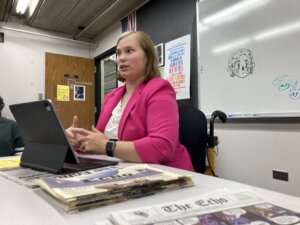
Talking helps.
It’s a truism high school senior, PSEO student, and podcast host Alena Skinner has put into action with her podcast, I Can Totally Do That.
“I started a podcast for people with disabilities to help them try to find their passions and their careers in life,” says Skinner, who started taking classes at RCTC in the fall of 2024. Next fall, she matriculates to Utah State to study political science.
The show is available on YouTube and Spotify. Skinner posted her first episode in February 2025, featuring an interview with Mason Shrader, a PhD student in archaeology at Brown University who has cerebral palsy.
“Right now, this is really just a passion project,” says Skinner.
Inspiration for the project came, in part, thanks to a 4H project, but has grown its own momentum. Skinner’s efforts so far have already garnered stories by the Rochester Post-Bulletin and the Cerebral Palsy Research Network. The process, says Skinner, has been educational.
“I’ve learned so many new skills. I didn’t even think that podcasting was this hard, but it is. I’ve learned so many wonderful things from it… I don’t think any of us are fast at learning new skills. So the way I balance that is first giving myself grace. I try not to put too much pressure on myself… I have a lot of commitments and I want to do well in school. School is a first priority for me,” says Skinner.
One of the skills she’s sharpened is time management. Striking a balance between a podcast, schoolwork, and her other extracurriculars takes forethought and discipline. She’s also learned to leverage her existing social networks as she recruits new guests to her platform. In addition to 4H and campus life at RCTC, Skinner is involved in the Cerebral Palsy Research Foundation. Her family is also a huge help.
“Luckily for me, my mom is a doctor at Mayo who works with kids with disabilities, like me. She has a lot of networks, because she talks and works with people who have disabilities. So that’s kind of where I first built my network,” says Skinner.
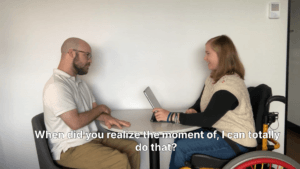 But the recruiting for, scheduling of, and performing of an interview is just the beginning. Skinner must also edit, post, and promote the show. One early dilemma – whether or not to use TikTok after it was ‘banned’ from the US. She avoided it, then TikTok had a resurgence. She says she’s learned a lot, much thanks to YouTube, and has enjoyed being able to put that learning into her shows.
“Like I’m learning in my social media classes, you always have to stay up on what social media is, what’s popular, and what the best tools are,” she says. “I’m new to this, so I’m learning to promote myself, which is a skill. I don’t think a lot of people know what I’m up to. The more voices, the more followers that I can get, I can get more opinions, more diverse thinking, different ways of approaching things.”
She is hoping to increase the frequency of her posts and to broaden her audience. In addition to Youtube and Spotify, Skinner has a presence on Facebook, Instagram, and Tiktok.
“My sincere hope is it brings you the confidence to find a job, a career, a experience,” says Skinner. “Especially for people with disabilities, I hope that this gives them a little bit more of a window into what is possible for them, even if the mainstream media isn’t presenting it that way, even if high school counselors aren’t presenting it that way to people with disabilities. I hope that this pushes them to find something that they’re truly passionate about.”
You can find Skinner’s podcast by pointing your phone’s camera at the QR codes in the center of this page. If you have an idea for a guest or want to talk with Skinner, send an email to
[email protected], or through direct messages on Facebook or Instagram.