
by Julia Noll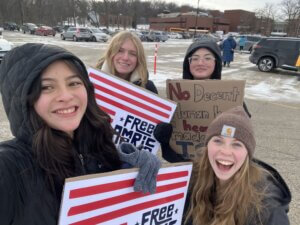
On January 20, one year after President Trump’s second inauguration, Grace Lunde walked out of RCTC. She left the atrium and walked along the trail leading through the front of campus. About twenty other people were marching with her, holding signs and chanting. As the group made their way towards the fitness center, people started joining them. Lunde watched as students and teachers threw on their coats and ran out to march with the group. By the time they reached the gym, 40 people were marching in total.
Across the country, tens of thousands of people marched out of their schools and workplaces in protest of recent political events in the country. The Free America marches were organized by hosts across the country, with PSEO student Grace Lunde hosting one at RCTC. Her reason for marching?
ICE.
“The big part of it, especially in that mid-January time, was ICE,” says Lunde. “ICE in Minnesota, ICE in Rochester. And I had known multiple individuals who had been threatened and had interactions. Luckily, none of them were detained, but it was a scary situation.”
Many of Lunde’s neighbors are immigrants, and she describes them as wonderful people who share their food and cultures with her family. ICE had recently patrolled her neighborhood, and Lunde felt inspired to march for her neighbors and all people threatened by ICE.
She had seen that people were organizing Free America walk-outs across the country, so she waited for one to be created in Rochester. As the day was getting closer and no one had organized one, Lunde decided to host one herself.
“And so I started organizing it through an organization called the Women’s March, and although they kind of set up a platform in order to be able to spread what you’re marching about and protesting about, everything else where you’re meeting, any sort of details, where to park, those sort of things are down to the person hosting the event,” says Lunde.
Lunde promoted the event through social media, word of mouth, and the Women’s March website.
She says it was inspiring to see people join the group as they were marching.
“People would come out of campus and, like, throw on their coats and then run out and walk with us, because they knew what was going on. And that was really crazy, because it wasn’t necessarily what they were planning on doing, but they saw that there was an opportunity for them to be able to stand up for what they believe is right, too,” she says.
In the wake of increased ICE activity in Rochester, Lunde says she has noticed fewer students on campus. She is also a senior at John Marshall High School and has seen ICE’s impact on Rochester’s most diverse high school.
“Especially when the semester started, it was kind of nerve-wracking,” she says. “How many people weren’t on campus, and then at JM a big thing was the students, and multiple students in my grade, who are people of color, are having to carry around their passports and their social security cards and these other super valuable and irreplaceable documents, so if they get stopped when walking home, they have this proof of, ‘Hey, I’m a citizen. I’m not fraudulent. I’m just a kid.’”
Around Rochester, many students and young people have had to become more cautious and wary of their daily routines so they don’t get picked up by ICE. Lunde notes that the ICE surge has caused people to question the relationship with law enforcement and protecting citizens, what that looks like, and whether they consider ICE a part of that enforcement or a separate entity altogether.
“We have seen a lot of significant, significant distrust in our government, and a lot of that is from 2020, where we had the incident with George Floyd, but then also the lack of responsibility taken at the start of Covid-19 and the pandemic, as well as now with sending basically untrained individuals with minimal background checks into our communities, armed and that are obtaining children without evidence. And when I say children, I mean children, like, we’re talking 16-17-year-old kids at work, at their jobs,” says Lunde.
Lunde foresees an increase of fear in the federal and state governments, as well as in law enforcement.
“I think that never in a democracy, what you should hear is that you’re afraid of your law enforcement and afraid of your government,” she says.
Despite fewer people on campus, Lunde still feels a strong community at RCTC. She started going to RCTC when she was 15 and has been surprised by how diverse the student body is, not just in terms of race but also in socio-economic status and age. She loves how students can interact with many different people and build connections.
After she graduates from RCTC this fall, Lunde plans to transfer to Mankato State University where she will start the nutrition and dietetics program. After graduating with her master’s, she plans to work for a while before returning to get her doctorate in physical therapy. Her goal is to be a physical therapist at the Olympic and Paralympic Training Center in Colorado Springs. She also wants to run a marathon.
Her own advice for people unhappy in the current political state?
“Speak out. I guess that’s kind of like the whole thing is, like, how I got in the situation is because I spoke out. And it doesn’t always have to be political. Like, yes we should speak out for what we believe in, in politics, in justice, in the radical issues we have. But it doesn’t always have to be speaking out against the negative. To speak out, to call out the positive. Like, ‘Wow, you did a great job on that.’ And maybe not everyone thought they did a good job, but you thought they did a good job, and that is something that that person likely wants to hear. So, yeah. So speak out. Speak out for the good and the bad,” says Lunde.