
by Julia Noll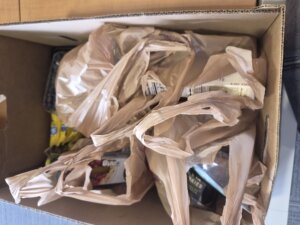
Every Saturday morning, 25-year-old RCTC student Noah Daly boards the city bus and rides to different food shelves. Then he rides to different houses across the city, delivering food to people too scared to leave their homes.
“I see a lot of people who need food,” Daly says, “and I have people who contact me constantly asking, ‘Hey, can you reach out? Can you get this? I’m too scared to go out. I need some milk for the house.’ Sometimes I can only do so much, and I have people reach out to me, and sometimes I have to say I don’t have the resources right now, and that’s always the hardest.”
Daly is many things. A Liberal Arts major. A hopeful voice actor. A son. He is also Rochester’s only Tlapixqui Brown Beret. He joined after being detained by ICE in early January.
It happened after an appointment at the Mayo Clinic in downtown Rochester. Daly stepped out of Gonda Building and was stopped by ICE. He had no ID on him besides his RCTC student ID. They forced him to kneel in the snow for 15 minutes before releasing him. When he tried to reach for his phone to bring up another form of ID, the ICE agents threatened to smash his phone.
After his detainment, Daly started looking into activist groups.
“At first I was looking into the Rainbow Coalition…I just so happened to see that the Brown Berets were on TikTok, so I reached out, I guess it was a hopeful Hail Mary, to see if I could get a response and see if there was something I could either start around my town or something I can do to help out. I got in contact with Commander Gutierrez, and she told me that she was starting a country-wide formation all over different states, starting different chapters for the Tlapixqui Brown Berets, and I told her that I wanted to start a chapter here. As far as I know, I was the first Tlapixqui Brown Beret in Minnesota for a couple of weeks.”
According to Daly, the Brown Berets are a pro-civil rights group created in California in the late 60s by a group of Chicano high school students. They were inspired by the Black Panthers and fought against racism and police brutality. After deconstructing in the 1970s due to concerns about safety, they were reformed in 2023 in Texas and Los Angeles. The Brown Berets are now spread across 14 states and stay connected online. The Tlapixqui Brown Berets are open to full-blooded or mix-blooded Latinos and Indigenous people. Daly notes that it doesn’t have to be Latino Indigenous. Any person of indigenous descent in any nation is welcome to join the Tlapixqui.
Some events the Brown Berets host are food drives, clothing drives, tutoring, bringing doctors and nurses to people without insurance, and helping people living with abusive partners move out.
With the recent surge of ICE, many Brown Berets have stood up to protect individuals from being taken. However, several Brown Berets have been targeted by law enforcement in the past.
“So a lot of the time, most of us won’t even say when we’re out there,” says Daly. “We do act, right, but we don’t advertise that we’re out there, and it makes it harder for us, having the community not know that we’re active.”
Daly’s family was worried for his safety as an active member of the Tlapixqui.
“As a Tlapixqui Beret, my family has set boundaries on what I can and cannot do because of safety reasons, not just for myself, because there’s things I’m willing to sacrifice, but I’m not willing to make those choices for my family, and they’ve made that clear,” says Daly. “I’m not a shield to be used in between ICE and someone else. I’m just here to help those afraid. I’m not going to throw myself in harm’s way.”
Daly’s mother was arrested by ICE in 2018. For six months, he says, she was imprisoned in a freezing concrete cage with other terrified, separated families. ICE passed down cruel and unusual punishments; they kept her in unsanitary conditions; they starved her of food and water to the point where her kidney failed.
To ICE, says Daly, she was just an illegal Mexican woman, until they finally processed her identification and allowed her to go. She was so weak, she had to be put on life support. ICE forced her to stay in Texas for three years, threatening that they would imprison her again if she left the state.
“It stuck with me,” Daly says, “and it made me think about my mother, and it made me think about what she used to do. She used to fight against ICE. She used to work for IMAA, MMIW and different health groups to keep ICE out of Minnesota, different protests, different events, even small things like fundraising or just awareness and brochures. And I was kind of raised around the idea that making a difference is important, and helping your neighbor and helping each other is important.”
Besides organizing food drives and delivering food to people’s houses by way of bus—an act that can take hours and even the whole weekend—Daly has also walked people home or arranged rides for people scared of being taken by ICE.
Most of Minnesota’s Brown Berets are located in the Twin Cities. Daly is the only Tlapixqui in Rochester. He’s hopeful about recruiting more individuals to join him in Rochester and other small towns in southern Minnesota.
Daly still feels like it’s not enough.
“Honestly, I feel like I could be doing more. I really do. I want to do more, and that’s part of the reason why I’m doing this, you know?” he says. “You don’t have to just fight ICE to help. There’s people who have been struggling for a long time. If you wanted to make a difference and you wanted to be a voice, this is a good way to do it…Just don’t be limited by the resources you don’t have. Just remember you can be that resource for someone else.”
People interested in learning more about the Tlapixqui Brown Berets can reach out to Noah Daly at [email protected].