
by Julia Noll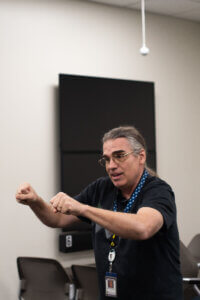
The tension on campus surrounding increased ICE activity in Rochester reminded English Instructor Mike Mutschelknaus, Ed.D of something. Especially the fear and uncertainty it stirred up for his immigrant students.
Twenty-five years ago, Mike Mutschelknaus was in the middle of teaching Freshman comp when terrorists flew planes into the Twin Towers in New York City, ushering in an era of fear and increased national security. Mutschelknaus remembers the tension on the day of 9/11 and the weeks that followed, especially for immigrant students unsure of how the government would respond and if there would be deportations.
“It was just like 9/11 in some ways,” Mutschelknaus said of the tense atmosphere surrounding ICE’s increased operations, “drawn out, complicated for students, lots of worry, not being able to figure out what to do, not knowing what was going to happen.”
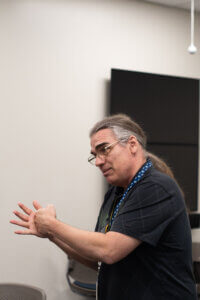
Mutschelknaus is known for his laid-back manner, ponytail, and sandals. He started teaching at RCTC in 2000 and was just named RCTC’s Outstanding Educator for 2025.
In all that time, 9/11 and the January 2026 Operation Metro Surge were the two periods he’s noticed a fear and uncertainty for his immigrant students.
Mutschelknaus noticed a dip in attendance during the surge.
“I teach, each of my classes has about 28 students in it… maybe two to three students in each class have decided not to come, and I understood that,” says Mutschelknaus.
“I reached out to the class as a whole and told them about the situation that was going on,” he says, “and if students had chosen not to come, I’d reach out to them individually to make sure that they could get the work made up, that kind of thing. I made a general class announcement, and then let them come to me about that.”
Professors and faculty struggled with finding the right balance of reaching out while adhering to their responsibilities. Mutschelknaus and his colleagues didn’t know how proactive to be with reaching out to students.
“How much do you not reach out to these students that are in distress?” he asks. “Do you make targeted individual efforts? Do you make general announcements like I did and let them come to you if a student is missing? Do you reach out and ask why? So there’s that kind of push and pull of how proactive we needed to be with helping our students. To that end, we were also very concerned about–how should I put it–if ICE would come to our doors. And we had campus guidance on that, and basically the campus guidance was, reach out to an administrator, inform them, don’t interfere as ICE performs their duties,” he says.
However, there was less guidance from administrators on how to help individual students who were affected by ICE. Mutschelknaus knows the administrators were also struggling with finding the appropriate response during the ICE deportations as there were different classroom and campus responses to adhere to. ICE has been in America for decades, but this was an unprecedented time for students and faculty being targeted by ICE.
Mutschelknaus urges students to reach out to their advisors, professors, and campus resources if they need help.
He says students should focus on their personal safety and needs. If they are being targeted by ICE or their safety is at risk, they should let their advisors know.
The RCTC faculty is dedicated to helping students. Professors have many resources they can provide to students if they feel unsafe coming to campus. Mutschelknaus says that students just need to communicate with their professors and advisors to let them know what’s going on.
“We can’t read students’ minds,” he says. “Every professor I know here wants to help students all that they can, but we need to know what you need and what you’re feeling for things like ICE and how we can help so we can bring in the support systems that we have.”
“There’s also, obviously, amongst my colleagues and myself,” says Mutschelknaus, “a lot of sentiment, concern for the students and ICE using the community college as bait. You know, we have a lot of students who are of populations that would be targeted by ICE, and we were quite concerned that they would just start camping out and, you know, waiting to see which students came through. So I did not like feeling that way.”
Even though the pressure from ICE has receded slightly since January, students are still wary.
“I imagine many of my students are still under considerable stress, and that would definitely affect your ability to learn. You only have so much brain space, and if you have X amount of brain space devoted to being concerned about ICE, you have less amount of brain space for chemistry, I would say. So, yeah, I think that’s still a very big concern,” says Mutschelknaus.