by Ethan Shones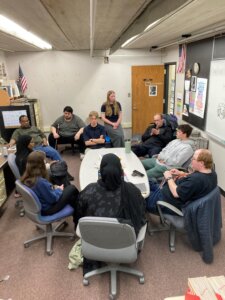
Friday, January 16th.
I was waiting for a meeting with my advisor about classes when I was stopped by a familiar sight: Hanging on the wall was “Freedom of Speech” by Norman Rockwell, an image I mainly know from Twitter users sharing their ‘bold’ takes. As my eyes scanned the document, a sense of dread slowly crept into my brain:
“STAND UP!
Join the Turning Point USA chapter at RCTC.
Every first and third Tuesday, starting January 20th.
2pm – East Hall, Room 237
Treats Provided!”
Turning Point USA is a conservative organization cofounded by conservative activists Bill Montgomery and Charlie Kirk in 2012 with the goal of advocating for conservative policies in high schools, colleges, and universities. You may know it in recent news for either A) Charlie Kirk’s highly publicized assassination. or B) The All-American Halftime Show, their attempt to protest Bad Bunny’s Superbowl halftime performance.
I’m going to get this out of the way: I did not like Charlie Kirk. The way I see it, the man made a career of making the lives of anybody who was a member of the LGBTQ+ Community and or an ethnic minority a living hell.
The poster bore a seal of approval from RCTC’s student life department on the back peering, long I stood there wondering, fearing: Why were they allowed on campus, especially now of all times? And who exactly was involved in this club?
The second question was easy to solve, RCTC has a list of student clubs and who runs them available to the public. The first question, however, would require me to dig a bit deeper.
I reached out to a member of student council to discuss this. It’s pretty easy to make a club, all you need are at least five members and a club advisor, and then you can announce the intention to create the club to the student senate. The matter of the club came up during a vote in December, and had some notable differences from usual senate votes; the senate vote was anonymous, which was unusual from what my source told me since they usually vote non-anonymously, and a little bit after the vote had occurred, the dean of student services contacted them and asked them to reconvene and talk about the vote and if they stand by it. The club was officially formed by a narrow margin (4 yes, 3 no). When I reached out to get more information, such as senate minutes for example, I received no comment.
I knew I wanted to write an opinion piece about the chapter, so I reached out to the club president, Andrew Jarett, and set up an interview. The club advertises itself as promoting civil discussion – I wanted to know why they would choose such a controversial organization as their vehicle for this. They accepted my invitation.
The newsroom was packed that day. We were joined by Jarett, members Lydia Gregory, Josiah Satterblom, Caleb Franklin, and club advisor Othelmo da Silva. Seven members of The Echo (including our advisor) were in attendance, too.
I will say, the interview went very well. Both sides were very respectful to each other; we didn’t descend into tribal combat. And I will say, the people in the club mostly seem like very nice people. But I still disagree with them about a lot of things politically.
All of the members met at their local church. They were all fans of Charlie Kirk. One of them had even gone to the last event he did before his final one in Utah, and another had gone to the event after that in Minneapolis, where Erika Kirk appeared in Charlie’s stead.
Jarrett says he had the idea to start the club in September, after Kirk’s assassination.
“I was personally a big fan of him. I liked his values, liked the way he debated. I thought it was very civil. I think we need that in our time,” said Jarett.
When I asked what the club wanted from RCTC’s campus, Lydia Gregory, another member, answered.
“Civil discourse for sure, being able to talk with different people from different backgrounds, with different opinions, different political, religious, etc., different ideas. Being able to do so in a calm and uplifting manner, so that nobody, I mean, yes, words can hurt, but being able to talk between two sides of the aisle or two different opinions. Maybe you won’t agree with each other in the end, but you’ll still have seen the other person’s side of the story, seen their opinion, and maybe have something to think about,” she said.
I wanted to know what the club thought of Kirk’s statements. Specifically, I referred to statements he’s made about The Civil Rights Act, calling it “a huge mistake” and an “anti-white weapon.”
Jarett’s response to this was as follows: “Context is very important. Personally, I think a lot of the times when people quote him, they don’t show the whole clip, and so they don’t know, like, all he’s saying.”
And I do agree; it is very important to show the full context. So, I went digging for it and found the clip. It’s from a discussion with conservative activist Jeremy Carl about his book “The Unprotected Class,” arguing that white people face systemic discrimination. That video will be linked at the bottom of this article1.
One aspect of the interview I wish I had done better was maybe push them a bit harder and talk more so I could hear more of their actual positions.
One topic that we talked about in depth, though, was ICE.
“First of all, I don’t know if any of us have had any confrontations with ICE directly, but I would say as a whole, I agree with what they’re doing personally…Now, could they be doing it in a better way? Yes, but I think it…always could be improving. So I agree with the idea behind ICE, enforcing the law. And… immigration enforcement, because…you need to have order…You need to have law…And you can’t have exceptions to that,” Jarett said.
This is a place I wish I would’ve asked about President Trump or the January 6 crew.
“I mean, my grandpa’s an immigrant. He did it the legal way… If you do it legally, I’m all for it. Having different cultures here is an amazing thing. I love being able to go down the street and getting different kinds of food, like, that’s great, but it’s when you do it illegally. You can’t make that exception for one thing and not for another…” said Jarett.
From there, the topic of Alex Pretti and Renée Nicole Good’s deaths came up.
“In my opinion, still don’t think they should have died, obviously, but I think that in a lot of ways, we should be highlighting more the deaths caused by illegal immigrants, like Laken Riley, people who have died because of people who weren’t supposed to be here legally. So the stuff that’s going on is very much an America First approach, and I personally agree with it, because we live in America, we should be putting American citizens first. We shouldn’t be prioritizing people who, I mean, they are still very much people. They’re very much still human beings, made in the image of God, loved by Him. But like Andrew said, there’s a legal process for a reason. In that legal process, not saying it’s easy, not saying it couldn’t be reformed. And I’ve heard it has been under some reform. One of our pastors at church said it’s way easier to get in the country now legally, that was a few years ago. So there is reform going. I think that’s a really good thing,” said Gregory.
So, did I change my mind? It hurts to write this, because the club members were so friendly, but no. I still don’t like the thought of the club being on campus. These are nice people. That doesn’t mean I have to like their ideas.
I do like that we talked peacefully in a room instead of screaming at each other from across an ideological cavern.
Is there a middle ground in our future? Time will tell.
For full transparency, if you are interested in hearing the full audio of the interview, email our advisor, Bryan Lund, at [email protected].
As mentioned earlier in the article, context matters, and I do not want to take anything they said in this interview out of context.
x