 Words and photos by Ethan Shones
February 20
A screen in the corner of the theatre goes through a slide show. It starts in the fall of 2001, featuring photos of a theatre production. It then goes to spring of 2002, and repeats this pattern all the way up to fall of 2025, a production of the children’s show “Ouch!”
Below this TV is a table with a wide assortment of food, from lasagna to tamales, to pizza, to fruit, and so on. RCTC students both old and current gather and tell stories, laugh, talk about their time at RCTC, followed by a series of performances.
What do they all have in common?
Aside from being RCTC students, these people have all been in a play directed by RCTC Theater Director Jerry Casper, who is retiring after some 70 productions and 27 years as a teacher at the college.
I was one of those students. I started working with him in fall 2021, when I appeared in his production of “Women,” a comedic adaptation of “Little Women.” Aside from 2025’s production of “Ouch!,” I have worked with him on every play since.
To celebrate his retirement, I sat down with Casper to talk about his career at RCTC as well as his last production here, “8 Minutes Left.”
March 26
I wait near the box office of the Hill Theatre for my interview. A couple minutes go by, and I see my interview subject poke his head out from the entryway to the theatre.
“Hey, could you help me out for a moment?” he asks me.
He’s spilled his coffee coming into the college.
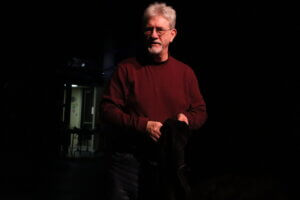
The man whose coffee I am helping clean up is Gerald (Jerry, for short) Casper, RCTC’s longtime theater director. After 27 years of serving as a teacher and theatre director here at RCTC, Jerry has decided to retire in order to focus more on writing and get back into acting as well.
“I have gotten into play writing so much. I love that. I still like directing, and I’ll still direct in the community. But I’m not young anymore. I’m 65, and I would like to just spend my time writing plays and seeing if I can get them produced,” says Casper.
Casper got his start with theatre in high school, thanks to a friend.
“A friend of mine, when I was a junior in high school, talked me into taking drama class…”
“…I was in choir, but I never really thought about theater, but he talked me into taking a drama class. So we took it together my junior year, and then again my senior year, and I just got really bit by it,” says Casper.
He got involved doing the curtains for play productions, and as he watched his friend up on stage acting, he says he thought to himself, “I think I could do that. I think I could do it.”
He auditioned for the school production of “Nanette” the next year and got his first role in the chorus.
continued on page 5
continued from front page
He also cited his drama teacher as a major influence, who helped him get into competitive speech (or “forensics,” as they call it in Kansas) after doing a monologue for a class project. He gave Casper the task of a one-person version of the Elizabethan tragedy “Doctor Faustus.” He had from Christmas until February to remember the lines and characteristics of nine separate characters.
Casper attended Fort Hays University in Kansas, where he got his Bachelors in Theatre before marrying his wife Ruth Casper, who teaches psychology here at RCTC. The couple moved to New Orleans after she got accepted into a PhD program after her BA.
“Because she’s brilliant,” says Casper.
A car crash would send them back to Kansas, where he went back to do his master’s degree, and it was there where he got into writing.
“I started writing pieces for myself, and eventually, when I was in grad school, I took a playwriting class and got really interested,” says Casper.
He wrote his first full length play, a one-person show called The Fourth Wall.
The play, says Casper, was “about a nerdy teacher who would stalk and murder students that picked on him, before ultimately revealing at the end that the audience was the ghosts of the students he had killed.”
The play was nominated for the American College Theater Festival, where it was selected it to be performed over one of their main shows and was nominated for the Irene Bryan Scholarship.
Casper has had two separate teaching gigs at RCTC. His first one started when his wife got an offer to teach here. He moved with her and got a part time job teaching speech and teaching at the Rochester Civic Theatre. He almost immediately set up an improv group.
“So I was like trying to piece together whatever I could to exist. And that’s how I got here the first time. Eventually that dried up and I had to leave because there were there was no work for me. Moved up to the cities, taught at Kaplan Educational System. My mother was really sick back in Kansas, and my drama teacher had left… and it just so happened that that high school position was open. I went back to Kansas and taught high school after that for for a while to be around my parents, until they both died,” says Casper.
“The week that I settled [my father’s] estate, and I’ve always thought this is meant to be, Greg Miller at Civic Theater called me and said, ‘Hey, Young People’s Theater position is open.’ (which doesn’t exist anymore).
Casper applied for the job, moved back to Rochester, and within a week, the tech director at RCTC told him the then-theater director was retiring.
“It was like, ‘Oh my gosh, this is the job that I should have. This is where I really want to be.’” says Casper.
And the rest is history.
Jerry’s last show here at RCTC is “8 Minutes Left” by E. B. Lee, a dark comedy consisting of non-sequential scenes surrounding how people are reacting to the end of the world. Interestingly, this was not his first choice. He had read a few different scripts alongside it, including initially planning to do a play he wrote himself. The whole time though, E. B. Lee’s script sat in the back of his mind. It appealed to him for two reasons.
First, the way the play is structured works well for scheduling, since almost every scene has different characters.
Second, the characters are very well written.
“I just think it’s a really good script…really interesting characters…I found…each scene…you’re kind of…seeing the ends of…multiple plays, essentially, because with… the whole idea of it being end of the world and all, every scene feels like final in…their own specific ways,” says Casper.
Looking back at his time at the college, Jerry remembers it very fondly.
“When I got this job, my predecessor left me a note and he said, ‘Really happy for you that you got this job.’ And he and I knew each other when I was here in the 90s. ‘It’s a really good gig. Be good to Gary Schott Snyder (who was the tech director) because he’s unique, and he was incredible – an artist.”
“Every job has its frustrations and its issues, but this has been a really good gig. My favorite thing about this job are all of you, the students that I’ve gotten to work with and have met and gotten close to in a way I don’t think you do in a regular job,” says Casper.
Those connections span geography and generations.
“I’m still in contact with…actors in New York and even people up in the cities who…do theater part time or don’t do theater at all anymore… I’ve made close friends with my students over the years, and that’s the best thing… I’ve been so lucky that my students have accepted me and like me. Feel like they’ve learned from me.”
“I feel like I’ve done something good with my life thus far, and I couldn’t think of anything else I’d rather do. This has been the best thing in the world, and it’s all connected to you all. It’s connected to students…I like you all. I like working with you. I like doing it. I wouldn’t change it. If I could go back and change it, I wouldn’t change it. It’s been great.”
x